Beyond the Code: A Founder’s Guide to Strategic Product Development in 2025

Clutch asked me some questions about this theme at the beginning of the summer. I got busy, but now I am ready to share Coderfy’s expertise. This product development guide for founders is based on my daily routine for the last few months. 

2025 Product development guide for founders

In this article

Share this article on:

From Our Research: What Founders Are Really Asking About “How to build a successful digital product”

We analyzed recent search query data to understand the most pressing questions business leaders ask when considering building a new product. The results clearly confirmed what we see daily in our client conversations.

 
“What are the exact steps?”: Demystifying the Process.

The highest volume of searches revolves around product development. People are looking for a clear, predictable path from idea to launch. Queries like “product development process steps,” “agile product development,” and “what is a product roadmap” dominate the landscape. This shows a deep need for a structured approach.

Our answer is always to start with a Discovery Phase to validate the core idea, create a clear Product Roadmap outlining the journey, and launch a Minimum Viable Product (MVP) to test the market quickly.

“What will this actually cost?”: The Budget Question

Unsurprisingly, founders’ top concerns are the “cost of developing a mobile app” and related queries. The fear of unknown costs and budget overruns can paralyze a great idea.

This is why our process is designed to provide clarity. The Discovery Phase isn’t just a formality; it’s where we define the scope and provide a detailed budget, turning a vague question into a concrete financial plan and preventing costly surprises down the line.

“How do I build a scalable business?”: The SaaS Dream

The term “SaaS product development” appears consistently with high search volume, indicating that founders aren’t just thinking about an app but about building a long-term, scalable business with a recurring revenue model.

This is a significant shift from creating simple, one-off projects. It requires a partner who understands the technology and the business architecture behind a successful SaaS platform, from user onboarding to subscription management.

But let’s continue with the Clutch Research Articles questions and product development guide for founders

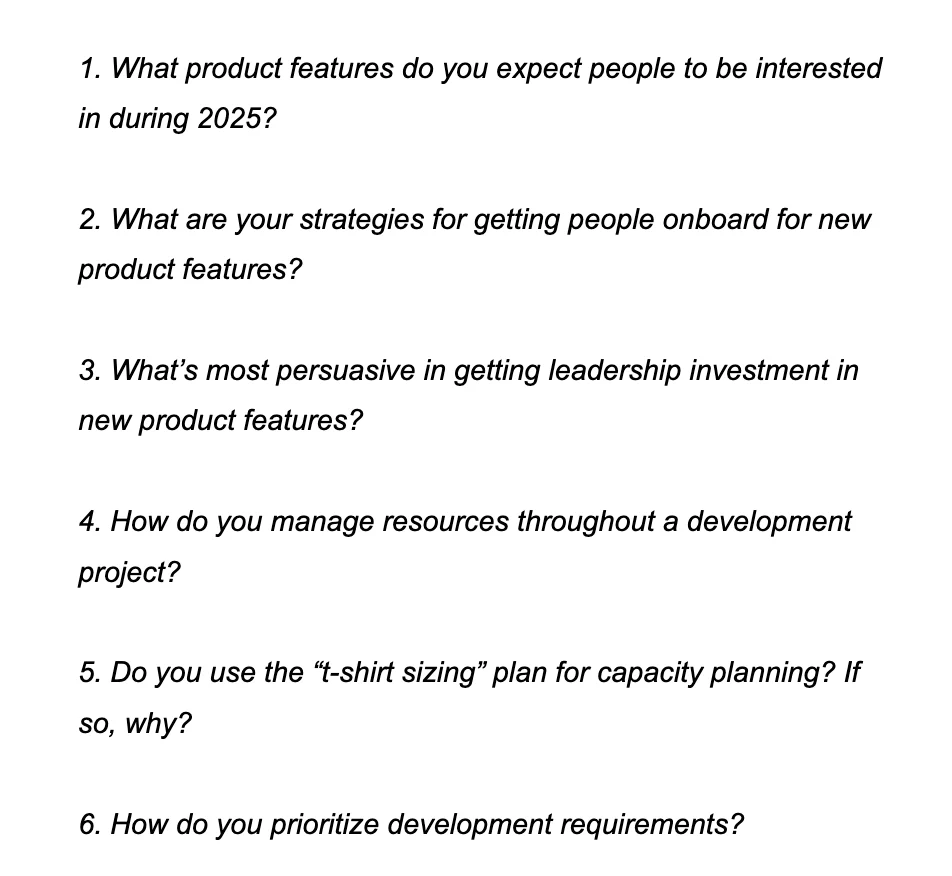
Screen from the e-mail that inspired the product development guide for founders
Screen from the e-mail

What Product Features Will Dominate in 2025? (Q1)

It’s less about specific gadgets and more about solving user problems in smarter, more integrated ways. Based on our work developing complex platforms, we see three key trends defining successful products next year.

  • Hyper-Personalization through AI: Users now expect experiences tailored to their individual needs. Generic is no longer good enough. We’re implementing this through AI-powered recommendation engines and intelligent chatbots that provide instant, relevant assistance. For service-based businesses, this means an app that not only books an appointment but also suggests follow-up services or products based on the user’s history, significantly boosting customer lifetime value.


  • Seamless System Integration: Standalone apps are becoming a liability. Users demand that their digital tools work together effortlessly. This is why we prioritize robust integrations in our projects, such as connecting booking systems directly to Google Calendar or embedding secure, multi-system payment gateways like Stripe into the user flow. The goal is to create a frictionless experience that fits into the user’s existing life.


  • Community and Engagement Features: People want to connect, not just transact. For service apps in the wellness or sports space, this means building features that foster a sense of community. We’ve seen great success with platforms that include features for finding partners, user ratings, and direct communication, turning a simple service app into a valuable social hub.


How Do You Successfully Onboard Users to New Features? (Q2)

A brilliant feature is useless if nobody knows how to use it. A strategic rollout is critical for adoption.

Our Onboarding Strategy

  • Start with “Why”: Before launch, we ensure all marketing communication (emails, social posts) focuses on the benefit of the new feature, not just its function. How does it save the user time, money, or effort?

  • Guided In-App Experiences: We combine subtle tooltips, guided walkthroughs, and pop-up announcements for first-time users of a new feature. This reduces the learning curve and demonstrates value immediately.

  • Feedback Loops: We integrate simple feedback mechanisms (like a one-click poll or a short survey) after a user tries a new feature. This provides invaluable data for future iterations and makes users feel heard.

How Do You Get Leadership Investment for New Features? (Q3 & Q6)

Getting buy-in from leadership requires translating a feature idea into a clear business case. This involves rigorous prioritization and a data-driven pitch.

Our Framework for Prioritization and Investment

  • Lead with Business Metrics: Every feature proposal must answer the question: “How will this move our key business metrics?” We prioritize requirements directly impacting revenue, customer retention, operational efficiency, or market differentiation.

  • Use a Prioritization Model: To remove emotion from the decision-making process, we use frameworks like MoSCoW (Must-have, Should-have, Could-have, Won’t-have) or RICE (Reach, Impact, Confidence, Effort). This ensures we focus development resources on features that deliver the most value.

  • Present a Clear Roadmap: We don’t pitch features in isolation. We present them as part of a larger product roadmap that tells a compelling story about where the product is headed and why each step is essential for achieving the long-term vision.


The MoSCoW Prioritization Framework

This framework is essential for deciding what to include in a product release (especially an MVP) by categorizing features based on their importance.

  • M – Must-have: Critical for Launch. The product is not viable without these features. They are non-negotiable.

    • Example: For a tennis app, user login and the ability to book a court are Must-haves.

  • S – Should-have: Important, but not Vital. The product can launch without them, but they add significant value and should be included if possible.

    • Example: Google Calendar integration and saving payment methods are Should-haves.

  • C – Could-have: Desirable, but Optional. These are “nice-to-have” features that will be included only if time and resources permit, without impacting the core release.

    • Example: A user profile “dark mode” or achievement badges are Could-haves.

  • W – Won’t-have: Out of Scope. These are features that are explicitly acknowledged but will not be included in the current release to avoid scope creep and maintain focus.

    • Example: Multi-language support or a social feed might be Won’t-haves for the initial launch.


How Do You Manage Resources and Plan Capacity? (Q4 & Q5)

Efficiently managing a team of 15+ specialists requires a blend of high-level planning and detailed project management.


Resource and Capacity Management at Coderfy

  • Full-Cycle Team Structure: Every project is assigned a dedicated team that includes developers, a project manager, UI/UX designer, and QA specialist. This ensures all aspects of the project are covered and communication is streamlined, preventing bottlenecks. The project manager acts as the single point of contact, providing clarity and transparency to the client.

     
  • T-Shirt Sizing for Initial Planning: In the early discovery and planning phases, we use the “t-shirt sizing” method (XS, S, M, L, XL) for capacity planning.

    • Why we use it: It’s a fast and effective way to get a high-level estimate of the effort required for each central feature without getting bogged down in hourly specifics too early. This lets us quickly align with stakeholders on the overall scope and priorities and build a realistic project roadmap before committing to a detailed development sprint.
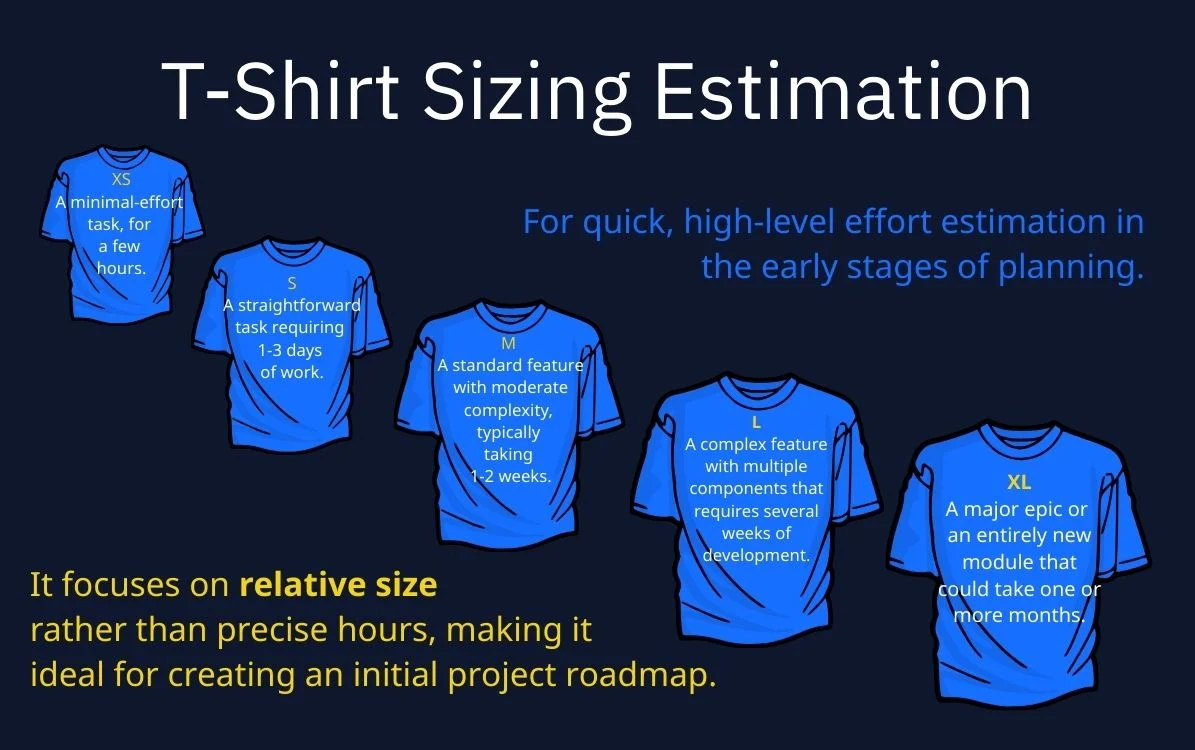

T-Shirt Sizing Estimation Concept as a part of the product development guide for founders

T-shirt Sizing for Capacity Planning 

This method is used for quick, high-level effort estimation in the early planning stages. It focuses on relative size rather than precise hours, making it ideal for creating an initial project roadmap.

  • XS (Extra Small): A minimal-effort task, often just a few hours.
    Example: A simple text change or a minor bug fix.

  • S (Small): A straightforward task requiring 1-3 days of work.
    Example: Adding a new field to an existing form.

  • M (Medium): A standard feature with moderate complexity, typically taking 1-2 weeks.
    Example: Building a new report page with filters.

  • L (Large): A complex feature with multiple components that requires several weeks of development.
    Example: Integrating a new third-party payment gateway.

  • XL (Extra Large): A major epic or an entirely new module that could take one or more months.
    Example: Building a custom administrative dashboard from scratch.

How exactly do you use the “T-shirt Sizing” concept in a real project?

That’s a great question. We use it right at the beginning, during the Discovery Phase, to turn a big vision into a manageable plan. After around 100 estimations from 2024 to 2025, it became part of our product development guide for founders.

Let’s take our Cosina – Spanish Food Delivery Platform project as an example. The client came to us to create a full marketplace. To create a realistic roadmap and budget, we broke the vision down into major feature sets, or “epics,” and assigned a T-shirt size to each one:

  • User Onboarding & Profile (Size: S – Small): This is a standard and essential part of the app, but the logic is well-understood (sign-up, login, edit profile). We know it’s a straightforward task.

  • Chef Dashboard & Menu Management (Size: M – Medium): This is more complex. It requires tools for chefs to upload menus, set prices, add photos, and manage their availability, representing a moderate effort.

  • Customer Ordering & Payment Flow (Size: L—Large): This is a significant effort. It involves browsing, searching, filtering, a shopping cart, and a secure payment gateway integration with Stripe. It is one of the most complex parts of the application.

  • Admin Moderation & Analytics Panel (Size: L—Large): Another large and complex undertaking is building a powerful backend tool for our client to manage users, moderate content, and view financial reports.

By doing this, we can instantly see that the core value (ordering and admin) requires the most effort. This allows us to have a strategic conversation with the client about what to include in the MVP, creating a realistic budget and timeline before a single line of code is written.


AI’s Role in Product Development Process for Startups

This won’t be a proper analysis without mentioning AI. 

1. How is AI actually used in product development? Is it just for chatbots?

While AI-powered chatbots are a popular feature, the role of AI in modern product development is much broader. We leverage AI in several key areas to create “smarter” applications:

  • Personalized User Experiences: AI algorithms can analyze user behavior to provide custom recommendations, suggest relevant content, or tailor the user interface, significantly boosting engagement and retention.

  • Data Analysis & Insights: For our fintech client Fintell.AI, our partner built a platform that uses AI to process and interpret complex financial reports, turning raw data into valuable, easy-to-understand insights for their users.

  • Automating Complex Processes: AI can automate tasks that previously required human judgment, from moderating user-generated content to optimizing logistics and scheduling.

  • Improving the Development Process: We also use AI tools internally to accelerate coding, improve testing accuracy, and identify potential bugs, making our development process more efficient.

2. Is AI a “must-have” for a new product in 2025, or is it just hype?

AI is not a “must-have” for every single product, but it is a powerful strategic advantage when applied to the right business problem. We don’t recommend adding AI just for the sake of it.

Instead, we start with your business goal. If your goal is to offer hyper-personalized recommendations, automate complex data analysis, or provide 24/7 intelligent customer support, then integrating AI is a critical component for success. The key is to ensure AI serves a clear purpose that enhances the user’s experience or your business’s efficiency.

3. What are the challenges or risks of integrating AI into a product?

Integrating AI does come with unique challenges, which is why a strategic approach is so important. The most significant are:

  • Data Quality: AI models are only as good as the data they are trained on. Ensuring you have a clean, robust, and unbiased dataset is often the most significant part of the project.

  • Complexity & Cost: Developing and maintaining custom AI models can be more complex and costly than traditional software features, especially because of the specialized talent required.

  • Ethical Considerations: Businesses must be mindful of user privacy and the ethical implications of how AI makes decisions.

Our role as your partner is to help you navigate these complexities, starting with a clear strategy to ensure the benefits of integrating AI far outweigh the risks for your specific business case.


Moving from a Vendor to a Partner

Building a successful digital product in 2025 requires a shift in mindset—from hiring a vendor to execute a task, to engaging a partner who can provide strategic guidance through the entire product lifecycle. By focusing on business outcomes, prioritizing ruthlessly, and managing resources with proven methodologies, you can ensure your next digital product isn’t just a collection of features, but a powerful engine for your business’s growth. 


Key Takeaways for Founders

  • Focus on Value, Not Just Features: The best products in 2025 will solve real user problems with AI-powered personalization and seamless integrations.

  • Justify Investment with Data: Use a clear prioritization framework (like MoSCoW) to translate feature ideas into a compelling business case for leadership.

  • Plan with High-Level Estimates First: Use methods like “t-shirt sizing” during the discovery phase to align on scope and budget before getting lost in details.

  • Choose a Partner, Not a Vendor: Success depends on a strategic partnership covering the full product lifecycle, from idea to launch.

  • Leverage AI Strategically, Not for Hype: AI is a powerful tool for personalization and automation. Still, it should always be tied to a clear business goal, not just added as a trend.

What's the biggest challenge you're facing in your product development journey? Share your thoughts in the comments below!

Coderfy

Have an idea? We have the expertise to make it happen

FAQ About Product Development Guide for Founders

Our approach is focused on delivering value and a strong return on investment, not just the lowest initial price. While a comprehensive process might have a higher upfront cost than hiring a junior freelancer, it’s designed to prevent the expensive mistakes that lead to budget overruns, missed deadlines, and failed products. Our initial Discovery Phase provides a clear, fixed budget for the scope of work, ensuring you have financial predictability. We build it right the first time.

While every project is unique, a typical custom mobile app MVP (Minimum Viable Product) takes between 3 to 6 months from the initial Discovery Phase to launch. This timeline generally includes: Discovery & Strategy (2-4 weeks), UI/UX Design (3-6 weeks), and Development & QA (8-14 weeks). Our focus is on launching a high-quality, market-ready product efficiently without sacrificing quality.

Hiring freelancers can work for small, well-defined tasks. However, building a successful digital product requires more than just code. As your product development partner, we provide a full-cycle, dedicated team: a project manager, a UI/UX designer, developers, and QA specialists. We bring strategic thinking from day one, helping you define your roadmap and ensure the final product is not only technically sound but also positioned for market success, as we’ve done for clients from the US to Sweden.

Our entire process is built on transparency and collaboration to prevent that from happening. We work in agile sprints, typically two weeks long, with a demo and review session at the end of each sprint. This means you see tangible progress and have the opportunity to provide feedback constantly. As your partner, our goal is to ensure the project is always aligned with your vision and business goals.

Our partnership doesn’t end at launch. We offer a range of ongoing support and maintenance retainers to ensure your product remains secure, up-to-date, and performs flawlessly. We also work with our clients on Phase 2 development, helping them analyze user feedback, plan new features, and continue to iterate and grow their product over time.

Coderfy software development company
This site is protected by reCAPTCHA and the Google Privacy Policy and Terms of Service apply.

Begin Your Project With Confidence -Contact Coderfy Today

Embark on your software development journey with the assurance of our expert estimate for software project service. Whether you're ready to discuss your project, upload documentation, or simply look for a product development guide for founders, our team will guide you every step of the way.

Put contacts to receive an estimate examples

This site is protected by reCAPTCHA and the Google Privacy Policy and Terms of Service apply.