1. The Modern Procurement Ecosystem: Rules of Engagement
The strategic transition from traditional B2B sales to formal procurement represents a fundamental shift from relationship-based influence to a document-centric, legalistic environment. For major institutional clients like Volleyball Canada, the BBC, or government bodies like the Department of Agriculture, Environment and Rural Affairs (DAERA), procurement is a strictly regulated process where transparency and fairness override personal networks.
In this arena, compliance is a binary gatekeeper. Failure to adhere to the “Instructions to Bidders” results in immediate disqualification. For example, the “no phone calls” rule—often enforced in high-stakes tenders—establishes a rigid legal boundary where the written submission is the sole instrument of evaluation.
Defining Formal Procurement
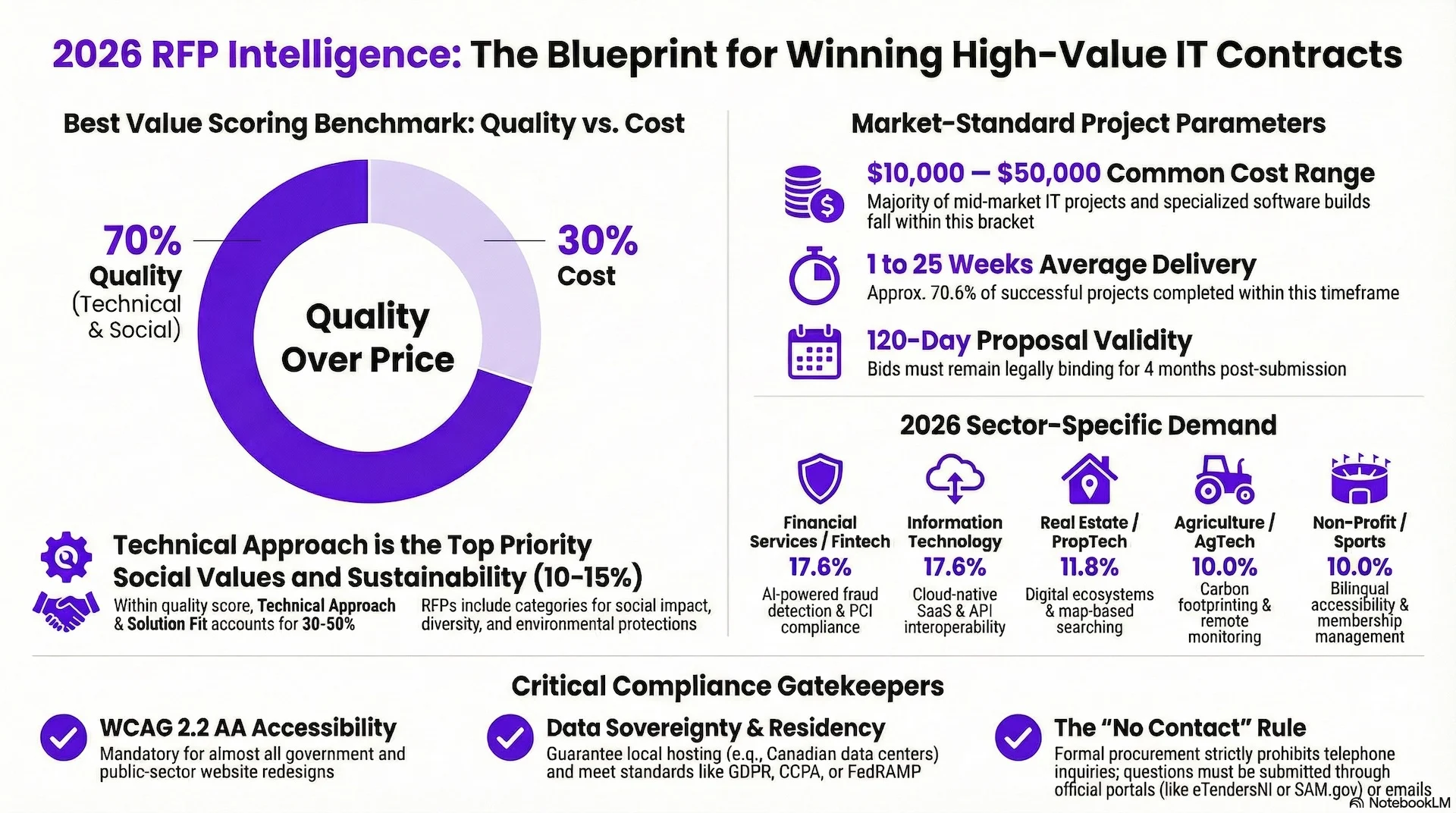
Formal procurement is characterized by meticulous categorization and the “Light Touch Regime” often applied to specific services. As evidenced in technical tenders, the process is structured to ensure “value for money” through explicit weighting systems, typically prioritizing quality (Technical Ability) over the lowest price.
Common Procurement Vocabulary (CPV) Mapping
To find the right opportunities, Coderfy monitors specific codes that reflect our technical excellence:
72212517: IT software development services (Core custom development).
72000000: IT services: consulting, software, support.
80420000: E-learning services (Essential for digital education tenders).
2. The Intelligence Phase: RFI and EOI as Market Entry Points
The “Stage Zero” of procurement involves non-binding but strategically vital interactions. Engaging here allows a firm to perform reconnaissance and influence technical requirements before the competition intensifies.
Request for Information (RFI): This mechanism ensures the framework’s requirements for “software engineering” and “quality assurance” do not favor legacy vendors. By participating, we promote our “Product Thinking” approach and shape the criteria to favor boutique firms with high-caliber talent.
Expression of Interest (EOI): The gateway to the shortlist. In systems like the UNGM (United Nations Global Marketplace), speed and brevity are paramount. An EOI response should be a punchy 1-2 page document confirming capacity and intent.
3. The Execution Phase: RFP vs. RFQ Methodologies
Entering the execution phase requires a cognitive shift between solution-oriented proposals (RFP) and price-driven quotations (RFQ).
| Dimension | RFP (Solution-Oriented) | RFQ (Price-Oriented) |
| Core Objective | Solve a complex organizational problem. | Acquire a clearly defined tool/service. |
| Selection Criteria | Best Value (70% Quality / 30% Cost). | Lowest Responsive Price. |
| Coderfy’s Edge | Product Thinking, UX/UI, and Discovery. | Technical Efficiency and Scalability. |
RFP (Request for Proposal) – The Technical Battleground
An RFP for website redesign demands a sophisticated “Technical Approach.” Coderfy maps its stack (Next.js, Headless CMS, Flutter) to the Technical Ability conditions. In cases where quality weight is 70%, we secure this by demonstrating how modern frameworks provide the modularity and scalability required for complex ecosystems.
4. Structuring the RFP Discovery: The “Coderfy” Standard
The RFP discovery phase is where the project’s DNA is created. A “Product Maker” doesn’t just list features; they define outcomes. When drafting or responding to an RFP, the following technical layers must be present:
Technical Stack & Architecture
We advocate for technologies that offer long-term ROI:
Frontend Performance: Why Next.js is non-negotiable for SEO and Core Web Vitals.
Backend Reliability: The use of Node.js/Nest.js for high-load systems.
API-First Approach: Ensuring the website isn’t a silo but a connected part of the business ecosystem.
Project Delivery Methodology (AC1)
Coderfy utilizes an Agile-Scrum framework. This ensures that “Instructions to Bidders” regarding project timelines are not just met but optimized. We provide:
Weekly sprint demos.
Transparent Jira/Linear backlogs.
Continuous Integration/Continuous Deployment (CI/CD) pipelines.
5. B2B Ecommerce RFP: Navigating Complexity
A B2B ecommerce RFP is significantly more complex than its B2C counterpart. It requires a deep dive into:
Complex Pricing Logic: Tiered pricing, contract-specific rates, and bulk discounts.
ERP/CRM Integration: Real-time data sync with systems like SAP, Oracle, or Microsoft Dynamics.
User Roles: Multi-user accounts with different purchasing permissions.
At Coderfy, we approach B2B ecommerce through the lens of “Discovery & Analysis,” reducing the buyer’s risk by identifying integration bottlenecks before a single line of code is written.
6. Strategic Recommendations for Opportunity Identification
Semantic precision in searching for contracts is the difference between finding a commodity gig and a multi-year partnership.
Target Keyword Expansion
Primary (Service-Led): Digital Transformation, Web Portal, Custom SaaS Development.
Secondary (Outcome-Led): Workflow Optimization, SCORM-compliant, Secure Computing Continuum.
Compliance Checklist (The “No-Fail” Gate)
Any “Red Flag” results in an automatic fail. Every submission must verify:
Communication: All queries through the official portal (e.g., eTendersNI).
Financial Readiness: Bank references in the correct currency (e.g., Euros for EU tenders).
Documentation: Signed “Model Acts of Acceptance” and “Proof of Market” references in PDF format.
7. Why “Product Thinking” Wins Tenders
In a sea of generic “dev shops,” Coderfy stands out by applying Design Thinking to the procurement process. We don’t just build what is asked; we build what is needed. This involves:
Discovery: Deep-diving into the user’s pain points.
Prototyping: Validating ideas early to save costs.
Technical Synthesis: Leveraging AI-driven automation (like GPT-agent integrations) to provide future-proof solutions.
Expert Insight: How to Use AI to Draft Your RFP Structure